
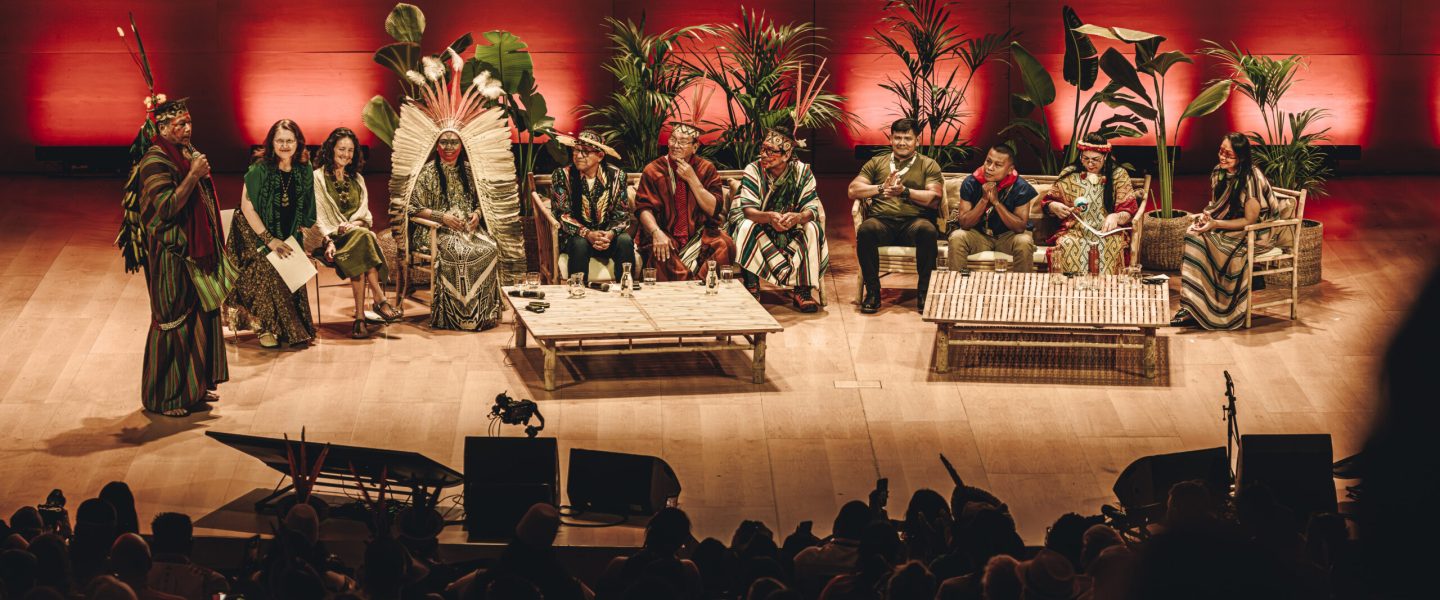
On September 11, more than a hundred Indigenous spiritual leaders entered the main auditorium of the Palau de Congressos in Girona, singing as they went. Hailing from 26 Amazonian peoples, they wore body paint, ceremonial feather headdresses, and carried maracas, moving in a circle while the audience — standing because not a single seat remained empty — remained silent. Many people burst into tears. No opening speech was needed: several Indigenous delegates and their families took the stage directly in a colorful parade of traditional attire, songs, and dances. When the ritual concluded and the Indigenous representatives formed a single circle, the entire hall rose to its feet in a standing ovation.
This is how the first World Ayahuasca Forum, held from September 11 to 13, began: a gathering that had been in the works for nearly a decade and brought together nearly 1,900 people and more than 180 speakers across five simultaneous venues. The event was preceded by the Fifth Indigenous Ayahuasca Conference, held in Brazil in 2025, where Indigenous communities denounced the uncontrolled commercialization of this medicine and issued a direct invitation to engage in dialogue with Western science. The Yorenka Tasorentsi Institute, the Nixiwaka Institute, and the ICEERS Foundation took up that proposal and jointly organized this gathering under the slogan “A New Time of Alliance,” which was projected in four languages behind the main stage throughout the three days.
During the press conference, Benjamin De Loenen, ICEERS’ Executive Director, summarized an idea that would run throughout the event: “We’re not talking about a substance; we’re talking about highly complex systems of knowledge.” The distinction was crucial: rather than focusing solely on compounds, effects, and applications, the Forum proposed also considering the cultural, spiritual, territorial, and political systems that have sustained these practices. The date was not chosen at random: September 11 marks the Diada, Catalonia’s national holiday, and Girona’s deputy mayor, Sílvia Aliu, thanked ICEERS and the two indigenous institutes during the opening ceremony for bringing this intercultural, ecological, and political conversation to the city — a land that knows all too well what it means to fight for one’s own freedom. She spoke like someone who truly understands what it means to want to preserve one’s own language, culture, land, and nature so that they may sustain our children — and their children — for many generations to come.
Friday: laying the groundwork
The opening ceremony brought together on stage, among others, Benki Piyãko Ashaninka, Nixiwaka Biraci Brasil Yawanawá, Pilar Vergés, Mona Polacca, and Benjamin De Loenen. Polacca, an elder of the Havasupai, Hopi, and Tewa peoples, a citizen of the Colorado River Indian Tribes in Arizona, a founding member of the International Council of Thirteen Indigenous Grandmothers, and a guardian of the Native American Church tradition, provided one of the most memorable moments of the day: she spoke of how “what is today called America” is indebted to the peoples who inhabited the banks of the Colorado River for millennia, and of how the world is sliding toward decline by refusing to honor the values and sovereignty of Indigenous peoples.
The first plenary session, “Ayahuasca, Ancestral Sciences, and Living Knowledge Systems,” once again brought together Benki Piyãko and Nixiwaka Biraci alongside Taita Luciano Mutumbajoy and Esneda Hurtado de Mutumbajoy. This was followed by “Recognition of Indigenous Sciences as a Bridge Between Worlds,” a conversation that laid bare one of the central tensions of the gathering from the very beginning. American ethnopharmacologist Dennis McKenna projected a slide summarizing his presentation: a message that, as he explained, ayahuasca itself had conveyed to him in 1993, warning humans that they are not the ones truly running the show, but rather the plants, fungi, and bacteria with which they have coevolved. He called mushrooms and ayahuasca “Gaian ambassadors” — species that have been on the planet far longer than we have and whose message, he insisted, is always the same: awakening. Alongside him, Emilia Sanabria and Chris Timmermann shifted the debate toward issues of authority and reciprocity, while Pashin Nima, Walter López, and Adana Omágua Kambeba pressed the question of who evaluates whose knowledge and who receives recognition, publications, or benefits when ancestral knowledge enters the laboratory. Kambeba, a doctor trained at a Brazilian federal university and in the process of becoming a pajé — or traditional healer — in her own community, summarized a position that would resurface throughout the weekend: “We do not expect Western validation.” Shortly afterward, in that same hall, biologist Monica Gagliano took the microphone without any prepared remarks: she said she felt almost like an enemy — a representative of Western science stepping onto a foreign stage — and that she had come only to listen and build alliances. It was a brief speech, though many in the audience would later describe it as one of the bravest gestures of the day.
Meanwhile, “Communication with the More-Than-Human: An Interdisciplinary Inquiry” featured presentations by Vari Puyanawa, Paul Stamets, Moisés Piyãko Ashaninka, and Monica Gagliano, although Stamets missed his flight to Girona and the session — moderated by Shawãkaya Shawãdawa and Jeremy Narby — proceeded without him. It was Narby himself who, from the podium, offered a distinction that would later circulate among the attendees: whereas neuroscience describes an encounter with “something,” many indigenous peoples speak of an encounter with “someone.” The difference goes beyond semantics, inviting us to rethink what it means to know a plant and what kind of relationship can be established with it.
In the afternoon, “The Journey of Ayahuasca: The Path of Globalization and Cultural Memory” brought together Carlos Suárez Álvarez, Luis Eduardo Luna, Fernando de La Rocque Couto, and Altino Machado. Suárez, a Spanish journalist and documentary filmmaker based in the Colombian Amazon since 2001, brings to this debate long-term research on the traditional use of ayahuasca in the region: his studies argue that this practice is considerably older than much of recent anthropological scholarship has suggested — a finding that shifts much of the discussion on cultural memory that took place at this roundtable further back in time. A few meters away, “Weaving Knowledge: Research on Ayahuasca and the Path Toward an Intercultural Science” brought together Dr. José Carlos Bouso, former scientific director of ICEERS, with Glauber Loures de Assis, Pashin Nima, Walter López, and Francisco Piyãko. Bouso, who had explained that “in controlled settings, ayahuasca causes no harm to health, neither mental nor physical,” argued before the audience that the psychiatry of the future will routinely prescribe psychedelics.
Other halls hosted discussions on anthropology, art and spirituality, mental health, research, Indigenous rights, markets, and intellectual property. In the session “Indigenous Rights, Markets, and Intellectual Property,” Joseph Mays participated alongside Fernanda Gebara, Alice Fusaro Faioli, and Tehseen Noorani in a conversation marked by a specific concern: preventing the global expansion of ayahuasca from ultimately turning indigenous knowledge into intellectual property owned by others.
The day continued into the evening on several fronts. In the Maloca on the third floor — a space with concentric circles where the elders spoke in the center, those who wanted to be close sat around them, and in the outer rings, people simply listened and rested. The Yawanawá family opened the Forum’s first concert around 7:30 p.m., dedicating the first twenty minutes solely to naming and acknowledging each of their relatives in attendance, before the first note was played. At the same time, Hall 3 hosted book presentations by Thiago Oliveira da Silva Novaes, Iara Silva Machado, and José Carlos Bouso, while in Hall 4, the evening’s chill-out area was filled with ambient projections designed to slow the pace after a full day of intellectual debates. The day concluded with the opening of the Maloca Warivi and the exhibition of the same name, featuring Daiara Tukano, Rita Huni Kuin, Yaka Huni Kuin, Zeltzin Mata, Vari Puyanawa, Joaquín Vila, and Delia Pizarro.
Saturday: controversial questions
The second day began with “Governance Through the Right Relationship: Reformulating Laws and Policies,” featuring José Gualinga, Pooven Moodley, Robinson Pai, Mayo Humberto Pai, and Juliana Sepúlveda, and with “Security, Ethics, and Best Practices: Working with Ayahuasca in Diverse Contexts,” where Jerónimo Mazarrasa joined Atira Tan and Benki Piyãko Ashaninka to discuss how to distinguish responsible facilitation from commercial exploitation. In another hall, Barcelona-based sociologist Jose Santiago Sánchez Roca participated in “Global Expansion: Critical Perspectives,” linking Zygmunt Bauman’s concept of liquid modernity with the boom in spiritual tourism to Iquitos. Later, “From Appropriation to Reconnection: Deconstructing the Logic of Owning Life” brought together Isku Kua Yawanawa, Antonio Daza Kulchavita, Puwe Puyanawa, and Joan Manel Vilaseca, while “Beyond Experience: Integration” brought together Marc Aixalà, Mijal Schmidt, and Gerónimo Tejedor from ICEERS, along with José López Sánchez, foreshadowing a line of work that the team at El Faro — ICEERS’ integration support service — will continue to develop after the Forum.
In the afternoon, “Consciousness, Ethics, Healing, and Responsibility” brought together Benki Piyãko Ashaninka, Silvia Mesturini, Ninawa Pai da Mata, and José López Sánchez to discuss the power that those who lead ceremonies can wield over people in particularly vulnerable states. At the same time, in Hall 3, “Between Molecules, Plants, Bodies, and Sounds” offered the Forum’s most technical segment: researcher Benjamin Mudge, from Maastricht University, explored the chemistry of ayahuasca (harmine and harmaline as MAO inhibitors, tetrahydroharmine as a serotonin reuptake inhibitor) and distinguished the “yellow” vine from the so-called “black” or “thunder” vine, before focusing on Peganum harmala, a plant that contains the same alkaloids as the Amazonian vine but in very different proportions, and which is used as a substitute in some concoctions sold as ayahuasca. Researcher Helle Kaasik, from the University of Tartu (Estonia), then presented an analysis of 453 samples of concoctions, in which she identified three categories (Daime, indigenous, and neo-shamanic) and demonstrated how traditional preparations maintain a balance among compounds that Western versions — loaded with DMT — tend to disrupt. A presentation by the Peruvian center Takiwasi closed out the session on a humorous note that many photographed: a slide claiming that “Takiwasi integrates natural intelligence (without AI) into its best practices.”
Meanwhile, “The Legal Landscape of the Global Defense of Ayahuasca” brought together Jesús Alonso Olamendi, also from ICEERS, along with Yama Nomanawa, Francisco Azorín, and Bernardo Chindoy to discuss a legal landscape that remains fragmented across countries, and “Voices of Resilience: Resistance, Peacebuilding, and Restorative Justice” featured Miguel Evanjuanoy Chindoy, Xiti Nukini, Maite Mompó, and Marta Salazar. In “Ayahuasca and Other Biocultures in Therapeutic Contexts,” Pamela Kryskow, Jem Stone, Sewa María García Valenzuela, Dráulio Barros de Araújo, and Rafael Guimarães dos Santos addressed the tensions between research and traditional stewardship: Araújo’s team had been extracting DMT from the sacred jurema plant for their studies in Brazil, but after hearing criticism from the communities that safeguard that knowledge, they opted to import synthetic DMT — even though the change forced them to suspend their research for a year.
The day concluded with book presentations by Marc Aixalà and Diego Rodolfo Viegas; followed by two well-attended concerts at the Maloca Warivi, which filled the dance hall well into the night, featuring ambient projections and a chillout session in Hall 4, as well as “Alliances of Knowledge” at the Maloca itself, with Imika Tarirú, Antonio Daza Kulchavita, and various Indigenous delegations. That same day, Benki Piyãko stepped up the tone of his accusations: while science studies plants while disregarding the ancient knowledge that underpins them, their uncontrolled use can lead to theft, madness, and death — reminding the audience that thirty leaders of his community currently live under threat from mining and oil. His speech culminated in an unequivocal demand: Enough!
Sunday: from dialogue to alliance
The final day began with the roundtable discussion “Weaving a New History for Humanity,” featuring Putanny Yawanawa, philosopher Charles Eisenstein, and Imika Tarirú. It was there that Eisenstein asked, in his characteristic gentle tone: “When do you think you’ll be ready to share your gift with us?” A tricky question, rooted in centuries of colonial pain and in these peoples’ legitimate right to protect their knowledge, but one that also offered a glimmer of real hope, now that the topic of alliance was finally being discussed.
In Hall 2, “The Dialogue Between Ancestral Indigenous Medicines and Other Medical Systems” brought together Adana Omágua Kambeba and Colombian physician Germán Zuluaga with Edina Shanenawa. Edina, a cacica and medicine woman from the village of Shane Tatxa Kaya in Acre — and the first woman in her community to receive the ceremonial headdress from her father — emphasized an idea there that echoed Kambeba’s remarks from Friday: that Indigenous knowledge neither needs nor seeks the endorsement of Western science. Days earlier, Daiara Tukano had voiced a question that ran through much of the gathering: “Do you really seek to end the war?” — questioning whether the growing Western interest in master plants aims to alleviate contemporary suffering at its root or simply turn it into a new market. And it was also Edina who summed up her demand in a phrase that circulated among the attendees: “Our territories are a living pharmacy.”
In the morning, the session “Beyond Prohibition: Toward Rights-Based Models” was also held, featuring Natalia Rebollo of ICEERS, alongside Tashka Yawanawa, Ismail “Izzy” L. Ali, and Beto Marubo. In the afternoon, during “Ayahuasca Self-Regulation and Harm Reduction Processes,” Taita Luciano Mutumbajoy shared the panel with Floris Moerkamp, Manuel Villaescusa, Eva Césarová, and Melissa Stangl. The Inga shaman from the Colombian Putumayo region emphasized that administering this medicine requires both clinical and spiritual responsibility: “The healer must know the patient and the illness in order to heal.” In “The New Economy of Life: From Extraction to Regeneration,” Azadeh Momenghalibaf, who has a background in global health and philanthropy, delivered one of the Forum’s most celebrated presentations as she spoke — drawing on her own Persian heritage — about building alliances with nature, the forest, and Indigenous peoples.
At the same time, discussions were taking place on decolonization, epistemologies, spiritualities, the environment, regulation, and law. In one of these, attorney Carlos Fernando Chica Cepeda returned to a seemingly simple question that ran through many of the others: who ultimately decides what deserves to be called medicine?
Mid-afternoon, Paul Stamets finally arrived, with his talk rescheduled after missing his flight on Friday and a title that seemed to carry a touch of irony: “Why Would a Mycologist Speak at a Conference on Ayahuasca?” Among his statistics, he cited an estimate that nearly 768,000 people worldwide consume psilocybin mushrooms daily. The Forum concluded with “Paths and Alliances for a New Era.” Benjamin De Loenen once again shared the stage with Benki Piyãko Ashaninka, Nixiwaka Biraci Brasil Yawanawá, Ernesto Evanjuanoy, and Gimar Lucitante before the closing ceremony. Three days after the opening song, the conversation thus returned to where it had begun: the possibility — and also the difficulty — of building an alliance between worlds that historically have rarely met on equal terms.
The human pulse, and what still lies ahead
To reduce what happened in Girona to the program of presentations would leave out an essential part of the gathering. Those in attendance highlighted the emotional weight of seeing, on a European stage, so many representatives of traditions that colonizers and missionaries had tried to suppress for generations. Mona Polacca, an elderly American woman, described the West as a sort of younger brother who one day left home and who, sooner or later, would have to return to seek guidance from Indigenous peoples.
The gathering did not shy away from its thorniest issues either. The discussion on consciousness, ethics, healing, and responsibility explicitly addressed the power that charismatic spiritual leaders can exert over people in altered states and in situations of extreme vulnerability — in line with the work ICEERS has been carrying out for years in the areas of safety and risk reduction. There were also moments when discussing territory no longer allowed for any abstract interpretation. The faces of Bruno Pereira and Dom Phillips — a Brazilian Indigenous rights activist and a British journalist murdered in 2022 in the Javari Valley — appeared on the auditorium screens. On that same September 11, as the Forum was getting underway in Girona, Colombian Indigenous leader Jacob Guachetá Zambrano was tortured and murdered in southern Colombia. According to data cited during the meeting, 39 land defenders were killed in Colombia and 26 in Brazil in the previous year alone. After reading those names on the screens, the words repeated throughout the weekend — territory, stewardship, protection, rights — took on a new gravity.
Some of the attendees themselves, as the Forum drew to a close, agreed that this represents a first step between two worlds that are beginning to walk together. Reconciliation, however, has not yet been fully achieved: it remains to be resolved how control over the narrative will be shared (whether Indigenous voices should, for example, review any article or study published about them). Nor has the fundamental debate been resolved: while the West has traditionally understood ayahuasca as a source of DMT, for many of the peoples who safeguard it, the essence of the medicine lies in the vine itself and not merely in one of its components.
At one point during the final day, at the Maloca, Colombian Muisca elder Antonio Daza Kulchavita summed up — perhaps better than anyone — the spirit that the Forum had sought to uphold over the course of three days: “We aren’t spiritual just because we do yoga or meditate. That isn’t spirituality. Spirituality is how we live, how we treat others, how we listen to them, how we care for other people.”
On Sunday night, an unofficial party was held by the Urban Indigenous Collective at the Platea venue, about a fifteen-minute walk from the Palau de Congressos. There, we sang and danced to the moving performance by Juan Calvi, Luz Esmeralda, and Taminchi, followed by a high-energy set by Josh on the turntables, all accompanied by visuals by Igor Domsac. Although it wasn’t part of the Forum’s official program, for many attendees it marked the way Girona finally bid farewell to ayahuasca.
What comes next
The Forum wasn’t conceived as an annual conference, but rather as a turning point. Among its stated objectives is the establishment, next year, of a Council of Indigenous Spiritual Leaders to provide institutional continuity to something that until now has depended largely on one-off meetings: the participation of Indigenous peoples in global decisions regarding the future of their own traditional medicines.
For ICEERS, the conclusion of the event also marked a return to work that continues to present new challenges every day. In conjunction with the Forum, the foundation made the AyaSafe documents available to the public for free download, offering practical tools for reducing risks in non-native contexts; presented a report on the economic impact of retreat centers in Costa Rica; and developed a new legal guide to help people understand the regulatory context before traveling.
For several decades, much of the Western world has approached ayahuasca by asking what it contains, what effects it produces, what ailments it can cure, or what risks it entails. The Forum added other questions: where does this knowledge come from, which territories sustain it, what obligations arise from receiving it, and who should be involved in decisions about its future. The alliance announced in Girona was not formalized in a document. Perhaps because an alliance of this nature can hardly be sealed with a signature. Its scope will depend, rather, on what happens next, as each person reflects on the experience upon returning home.
Thanks to Josh and Aili, Ben, Débora, Jerónimo, Àlex, Saioa, Carol, Priscila, Carlota (and her sister), Andrea, Kiko, Patricia, the French team, Emilie, Diane, Ségolene, Yorenka, and Nixiwaka, to all the volunteers, the Palau staff, and those of us who kept the set running behind the scenes, the donors, the organizations, the international press, the Indigenous delegation, the hugs and smiles in the hallways, Javi, María, Sarai, Miguel, Juan, Esmeralda, the catering team, the cleaning crew, the security team, and to everyone in attendance. Together, we’ve created a historic milestone that will be remembered for generations to come, so that one day we can proudly tell our grandchildren that we, too, were there, weaving together an unforgettable gathering. As Paul Stamets said in his talk on Sunday, this was probably “by far the most important conference I’ve ever attended in my entire life.”
Photo by Soulfocus Media.