
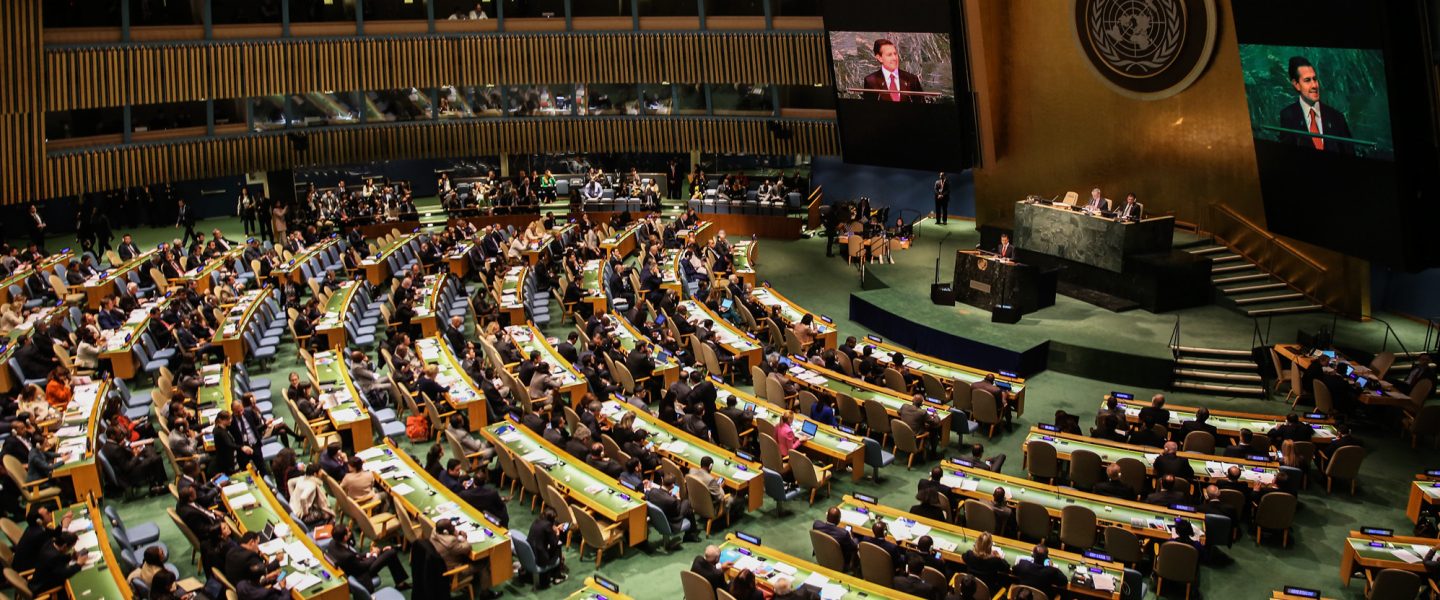
On April 21, 2016, the United Nations General Assembly Special Session on the world drug abuse problem (UNGASS) introduced a subtle but consequential shift in the vocabulary of global drug-access policy. The conventions remained intact, the schedules unchanged — yet the outcome document opened space for a different kind of conversation, one that placed human rights, public health, and proportionality closer to the center of international debate. A decade later, that shift deserves scrutiny, not commemoration.
The UNGASS outcome document acknowledged that responses to substances that may induce psychoactive states cannot rest on punitive approaches alone. It created room for health-oriented policies, harm reduction measures, and a broader recognition of social and cultural contexts. Yet this opening has unfolded unevenly, constrained by entrenched interpretations of the conventions and by the political inertia that tends to outlast any single multilateral moment. What emerged in 2016 was a shift in language — and language, without the institutional will to act on it, has a limited shelf life.
An agenda written, not enacted
If the 2016 outcome document was a shift in language, the more interesting question is what a full translation of that language into practice would have required. That translation already exists. In March 2019, less than three years after UNGASS, the International Centre on Human Rights and Drug Policy at the University of Essex, together with UNDP, UNAIDS, WHO, and OHCHR, released the International Guidelines on Human Rights and Drug Policy — a document that took the human rights commitments scattered through a decade of political declarations and organized them into a coherent account of what States actually owe the people affected by their ‘drug laws.’ The Guidelines do not create rights. They read the existing corpus of international human rights law through the lens of ‘drug control,’ and in doing so they make explicit the obligations that UNGASS gestured at and then left to interpretation. Read alongside the 2016 text, they function almost as a concordance: each cautious UNGASS formulation finds, in the Guidelines, the specific obligation it implies.
Seven years after their publication, and ten after UNGASS, the Guidelines remain the clearest available map of an agenda that has barely begun. They also remain, in most jurisdictions, unimplemented. The gap is not for lack of clarity. It is a gap of political will, and the contours of that gap are worth describing precisely.
What the Guidelines require
UNGASS opened a space for health-oriented responses; the Guidelines fill that space with content. The right to the highest attainable standard of health, as applied to ‘drug policy,’ requires States to make harm reduction services available, accessible, and adequately funded — not as tolerated pilot projects but as a component of a legal right. It requires access to evidence-based drug dependence treatment on a voluntary basis, grounded in informed consent, and the closure of compulsory drug-user detention centers where they still exist. It requires that ‘controlled medicines’ — for pain, for palliative care, for opioid agonist therapy — be available without the regulatory barriers that leave whole populations without relief. Ten years on, the availability of these services remains patchy at best across much of the Global South and uneven even within wealthy States. The epidemiological case has been settled for longer than UNGASS itself has existed. The political case has not.
The same gap opens around criminal justice. UNGASS 2016 asked States to promote proportionate sentencing; the Guidelines specify what that means. People should not be detained solely on the basis of drug use or dependence. Pre-trial detention for drug-related charges should be exceptional rather than routine. Diversion should be prioritized for minor offenses. And, on the question that UNGASS was unwilling to name at all, the Guidelines are unambiguous: drug offenses do not meet the international threshold of “most serious crimes” for which the death penalty — where it persists — may be imposed, and States have an immediate obligation to halt executions, commute sentences, and abolish the penalty in this context. In 2025, roughly 46% of recorded executions worldwide were for drug offenses, according to Harm Reduction International’s Global Overview. Ten years after UNGASS, 36 States retain capital punishment for such offenses, and several continue to carry it out.
The rights UNGASS left unnamed
Some of the most consequential sections of the Guidelines address precisely the rights that the 2016 document handled at arm’s length. The freedom of thought, conscience, and religion is recognized as applying to those whose practice involves the use of ‘controlled substances,’ with an express recommendation that States consider exemptions for cultivation and use in religious rituals and ceremonies. The right to enjoy cultural life is extended, without qualification, to those who use ‘controlled plants’ (noting it is not plants that are controlled, rather our access to using/experiencing them) for cultural, spiritual, or religious purposes, and to those who cultivate them as a traditional way of life. Indigenous peoples are treated not as a marginal case but as the subject of a dedicated section covering self-determination, free prior and informed consent, the right to enjoy culture and practice religion, and — most importantly for the communities at the center of these debates — the right to traditional medicines and health practices, including plants with psychoactive properties. Where UNGASS, in its only substantive reference to traditional use, asked States to “take due account” of historical evidence, the Guidelines ask States to refrain from depriving Indigenous peoples of the right to cultivate and use plants that enable psychoactive mind-states essential to the health and wellbeing of their communities, and to repeal laws that interfere with that right. The difference in register is the difference between an aspiration and an obligation.
What the Guidelines make visible, read against UNGASS at ten, is that the programmatic work was done — and that the harder work, of bringing national law and institutional practice into alignment with it, has barely been attempted. Crop eradication that ignores environmental impact assessment and the right to subsistence; compulsory treatment regimes that cannot survive scrutiny under the prohibition of cruel, inhuman, or degrading treatment; harm reduction services criminalized as “incitement;” the denial of ‘controlled medicines’ to children and to the dying; the criminalization of association and expression around drug policy reform — each of these is addressed, directly and in operational terms, in a document that has been sitting on the table since 2019.
When the categories don’t fit
Nowhere does this tension become more visible than in the treatment of traditional plant medicine practices, including those involving ayahuasca, iboga, peyote, San Pedro, and coca leaf. These practices do not fit within the categories that shaped the international control system. They carry relationships, knowledge systems, and cultural frameworks that precede and exceed the legal architectures designed in the twentieth century, and the friction that results reveals something deeper than a classification problem.
Part of that friction originates in language itself. Much of the prevailing terminology frames “drugs” as objects subject to control, obscuring the more precise reality: that legal systems regulate people — their practices, their relationships, and their access to different states of consciousness. Phrases like “illegal substances” or “drug control” suggest that plants or molecules themselves fall within the scope of prohibition, when what attracts legal consequences, in practice, are people’s actions and the contexts in which they occur. This distinction matters not only for accuracy but for policy. A framework that treats a plant as the unit of concern will consistently misread situations where the relevant variables are cultural, relational, and contextual. Restoring that human-centered framing does not require dismantling existing instruments — it requires reading them more honestly.
The 2016 document offers some basis for doing so. It called on States to promote “proportionate national sentencing policies, practices and guidelines for drug-related offenses” — a formulation whose distance from practice, a decade later, speaks for itself. Yet even before the session opened, a group of UN human rights experts warned that the existing policy approaches contributed to “an environment of increased human rights risk,” and that the outcome document, despite its improved language, failed to sufficiently articulate the human rights standards the moment required. The decade since has not dissolved that tension. Without active interpretation and deliberate application, principles function as rhetorical cover rather than operational commitments.
Flexibility exists — the question is will
In recent years, various jurisdictions have moved beyond strict convention-based interpretations when domestic priorities demanded it. These developments, uneven, sometimes contradictory, occasionally cynical, nonetheless reveal a system that, while rigid in form, retains flexibility in practice. That flexibility could extend, and in some cases already extends, to the recognition of traditional plant medicine practices, provided that policy discussions engage seriously with the rights and lived contexts involved. Whether the system permits this is hardly in dispute. What remains unclear is whether sufficient political will exists to pursue it.
For communities that steward these traditions, the stakes reach well beyond legal classification. At issue is the protection of cultural identity, the transmission of knowledge across generations, and the capacity to maintain relationships with plants whose significance — social, spiritual, ecological — operates on registers that policy documents struggle to accommodate. Any framework that passes over these dimensions does not merely fail those communities; it fails to understand what it purports to regulate. Moreover, Indigenous healers have been detained at borders thousands of kilometers from their territories, in jurisdictions whose legal systems have no category for what they do. For more than a decade, ICEERS has documented these cases and supported the communities and individuals caught in them, and the pattern is consistent across the file: the categories fail not because the facts are obscure but because the categories were built to see something else.
The pattern extends beyond Vienna. On April 18, 2026 — three days before this anniversary — the United States signed an executive order directing the FDA and DEA to accelerate research and expand access to compounds that induce psychedelic mind-states. The order frames ‘psychedelics’ exclusively as medical treatments, with no reference to cultural or traditional contexts. It nonetheless illustrates the same dynamic: the system moves when a State with sufficient weight decides to act, and on the terms that State chooses. It is also worth noting that, during the signing ceremony, Bryan Hubbard, CEO of Americans for Ibogaine, did address “our brothers and sisters in Gabon — you have our deepest gratitude for your stewardship of the sacred tree grown for the healing of nations.”
Three moments in Vienna
The decade after UNGASS has been marked by the slowness with which language travels into practice, but it has also produced three moments in which the multilateral system itself was forced to move. None of these was a moment the Commission on Narcotic Drugs had chosen to have. Each was the result of sustained pressure from outside the Vienna consensus, and each tells a slightly different story about what the international ‘drug control’ system is capable of conceding when the evidence becomes impossible to hold at bay.
Cannabis, and a close vote
The first of these moments concerned our relationship with cannabis. In January 2019, the WHO Expert Committee on Drug Dependence issued a set of recommendations that, had they been adopted in full, would have reorganized the international treatment of the plant for the first time since 1961. The core recommendation — to delete cannabis and cannabis resin [1] from Schedule IV of the Single Convention, the most restrictive category, reserved for substances considered particularly harmful and of limited medical value — was a recognition that the evidence had moved, and that a schedule designed before clinical research on cannabinoids existed could no longer be defended on scientific grounds. In December 2020, the Commission on Narcotic Drugs voted on the recommendation. It passed by 27 votes to 25, with one abstention. The margin is the story: a rescheduling justified by two decades of accumulated evidence, endorsed by the treaty-designated scientific body, cleared the Commission by two votes. The other WHO recommendations on access to cannabis were rejected. The system had moved, under protest and at the narrowest possible margin.
Coca, and the return to the beginning
The second moment was meant to be a correction of a much older wrong. At Bolivia’s initiative, supported by Colombia, the WHO Expert Committee on Drug Dependence undertook the first critical review of coca leaf since its inclusion in Schedule I of the 1961 Convention. That inclusion was based on the 1950 report of the UN Commission of Enquiry on the Coca Leaf — a body that visited the Andes briefly, consulted no Indigenous communities in any meaningful way, and produced conclusions about coca chewing now widely understood to have been shaped more by the racial assumptions of its era than by any rigorous scientific assessment. The critical review ran for two years. The four international teams of scientific experts commissioned to examine the evidence concluded that coca leaf chewing and infusion do not produce clinically meaningful public health harms, and that the literature is consistent with the WHO’s own 1995 cocaine study, which reached the same conclusion and was then suppressed under political pressure. In October 2025, the 48th ECDD met in Geneva; in December 2025, its recommendation was formalized in a letter from the WHO Director-General to the UN Secretary-General. Coca leaf access would remain in Schedule I.
The reasoning offered for that recommendation rested not on the scientific record of coca itself, which the Committee acknowledged did not support continued scheduling on public health grounds, but on the “convertibility” of the leaf into cocaine — a criterion applied to the raw plant rather than to the practices that give it cultural, medicinal, and nutritional meaning in Andean-Amazonian communities. The result is an almost literal reaffirmation of the 1950 framework: a scientific body acknowledging that the evidence does not justify the control regime it is nonetheless recommending. Indigenous rights, which the ECDD secretariat held to fall outside its mandate, did not enter the analysis. The coca review is now the clearest case study available of what happens when the UN drug control system is given the opportunity to confront its colonial inheritance through its own procedures — and of the limits of reforms built entirely on internal technical review.
Harm reduction, and a vote that broke the room
The third moment was, by Vienna standards, without precedent. At the 67th session of the Commission on Narcotic Drugs in March 2024, a resolution tabled by the United States — for reasons that had everything to do with the domestic opioid overdose crisis — proposed language on preventing and responding to drug overdose that included, for the first time in the Commission’s history, the words “harm reduction.” The term had been agreed language elsewhere in the UN system for more than two decades, since the 2001 Political Declaration on HIV and AIDS, but the Commission on Narcotic Drugs had kept it out of its own resolutions under the so-called “Vienna spirit” — the convention that all texts be adopted by consensus, which in practice granted a small number of conservative States an effective veto over progressive language.
On 22 March 2024, Resolution 67/4 was adopted: 38 States in favor, two against, with several delegations not taking part. It was the first time the Commission had passed a resolution by vote since 1985, and it did so on the question of whether to name, once, in a single paragraph, a public health approach that the rest of the UN system had long since accepted. What Resolution 67/4 achieved, and what it revealed, are two different things. The achievement was a breach in the lexical blockade that had held for nearly forty years. The revelation was that the blockade had been holding not through argument but through procedure, and that the procedure could be broken when a sufficiently motivated State decided the cost of consensus had become higher than the cost of a vote. The “Vienna spirit” survived in name. Its function as a brake on public health language did not.
Ten years on
Read together, these three moments describe a system that can move, but only under duress, and only at the exact margin where the evidence becomes unanswerable or the political cost of inaction becomes untenable for a State large enough to force the issue. Access to cannabis moved because of decades of scientific accumulation and the weight of domestic reform in several jurisdictions. Access to coca did not move, despite comparable evidence, because no State with equivalent weight chose to make the case its own. Harm reduction moved because the United States, confronting its own crisis, reversed a position it had held for thirty years. The international ‘drug control’ system, at ten years past UNGASS, remains capable of changing on precisely the terms that its architecture permits: slowly, narrowly, and under conditions it does not itself generate.
The tenth anniversary of UNGASS is less an occasion for verdicts than for an honest accounting of the distance between what was promised and what has been built, and for renewed attention to the communities whose practices remain most exposed to that gap. The path forward does not lie in opposition between control and culture, nor in the comfortable assertion that the system simply needs more time. It lies in recognizing that policy frameworks incapable of accounting for context will keep producing the same misalignments, dressed in progressively updated language. Ten years is long enough to notice the pattern.
[1] Readers please note that such attributions are incorrectly attributed to a substance, rather than the context of use or misuse of them.
Photo by Presidencia de la República Mexicana on Flickr.